FREE SHIPPING SELECT PRODUCTS FOR US ORDERS OVER $55

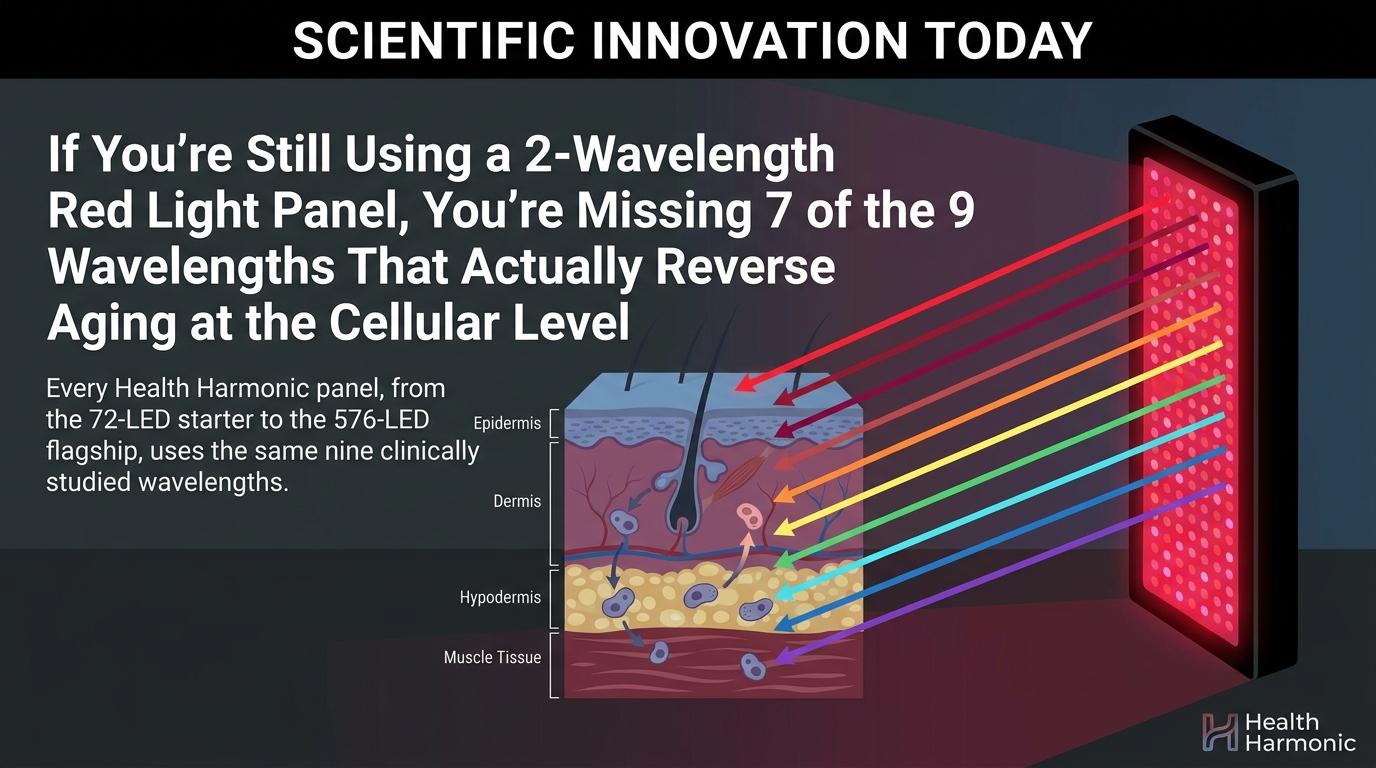
If You're Still Using a 2-Wavelength Red Light Panel, You're Missing 7 of the 9 Wavelengths That Actually Reverse Aging at the Cellular Level
Every Health Harmonic panel — from the compact 72-LED starter to the full-body 576-LED flagship — uses the same nine clinically studied wavelengths. Here's what that means for your results.
I spent six months studying photobiomodulation research before I understood what was actually happening inside my cells. Not the marketing. Not the wellness-bro Instagram posts. The actual peer-reviewed science on how specific wavelengths of light interact with cytochrome c oxidase, the enzyme that sits at the heart of your mitochondrial electron transport chain.
Here's what shocked me: the therapeutic window for light-based cellular repair spans from roughly 480 nanometers all the way to 1060 nanometers. That's a 580-nanometer range of clinically relevant wavelengths. And yet, nearly every consumer red light panel on the market uses exactly two of them: 660nm and 850nm.
Two wavelengths out of nine. That's 22% of the therapeutic window.
If you've been using a standard panel and wondering why your results plateaued after the first few months, this is almost certainly why. You've been getting a fraction of what photobiomodulation can actually do.
Your Body Is Not a Single Layer
Here's the physics that most panel manufacturers would rather you didn't think about: different wavelengths of light penetrate human tissue to different depths. This is not controversial. It's the Beer-Lambert law, high-school physics.
Blue light at 480nm interacts primarily with the epidermis. Amber at 590nm reaches the uppermost dermis. Red light at 630 to 670nm penetrates 2 to 3 millimeters, where your fibroblasts produce collagen. Near-infrared at 810 to 850nm reaches 1 to 2 centimeters, deep into muscle tissue and joint capsules. And 1060nm goes deeper still, reaching tissues that standard NIR never touches.
When you use a two-wavelength panel, you're treating two depths. Your skin surface and your shallow muscle. Everything in between — and everything deeper — gets nothing.
It's like owning a toolbox with a hammer and a screwdriver and calling yourself a contractor. Useful tools. Incomplete kit.
What Happens When You Use All Nine Wavelengths
Every Health Harmonic panel uses the same nine clinically studied wavelengths. Not two. Not four. Nine. Here's what each one targets:
480nm (Blue): Surface-level support for skin clarity and oil balance. Targets the epidermis where bacterial overgrowth and inflammation begin.
590nm (Amber): The uppermost dermis. Supports microcirculation and skin tone at the layer where visible redness and uneven pigmentation live.
630nm, 660nm, and 670nm (Red spectrum): Three distinct red wavelengths rather than one. Each hits a slightly different peak on the cytochrome c oxidase absorption curve. This is where collagen synthesis, cellular repair, and surface-level rejuvenation happen. NASA's original wound-healing research centered on 670nm specifically.
810nm, 830nm, and 850nm (Near-Infrared): Deep tissue penetration. Muscle recovery. Joint support. Mitochondrial function. Three NIR wavelengths reach different tissue depths rather than relying on a single frequency to do all the work. The 810nm wavelength in particular has drawn attention from researchers studying transcranial application — it penetrates bone.
1060nm (Deep Infrared): The deepest-penetrating wavelength in the lineup. Reaches tissues that standard NIR panels never touch. If you're dealing with deep joint pain or chronic inflammation that sits below the muscle layer, this is the wavelength that gets there.
When you stand in front of a Health Harmonic panel, you're not getting "red light." You're getting a full-spectrum photobiomodulation session. Every relevant wavelength, every relevant depth, in one session. No gaps.
The Engineering That Makes This Possible
Putting nine wavelengths in one panel is harder than putting in two. It requires more LED types, more complex driver circuitry, and more thermal management. Most manufacturers don't do it because it costs more and complicates their supply chain. We do it because the physics demands it.
Every panel uses 5-watt dual-chip LEDs: two emitters per diode, doubling the photon density compared to single-chip alternatives. Combined with a 30° and 60° mixed beam angle, the light reaches both deep and wide. You don't need to stand six inches from the panel trying to catch the beam.
The housing is powder-coated iron, not plastic. The control interface is a full touchscreen with independent dimming from 1 to 100% and per-wavelength adjustment. No app. No subscription. No Bluetooth pairing ritual. Plug it in and go.
LED lifespan: 100,000 hours — over 20 years of daily 20-minute use
Failure rate: 0.3% across the entire product line
Warranty: Full 3 years, parts and labor
Light intensity: ≥1400W/m² total output at 6 inches
Power: 100–240V AC, plugs into any standard outlet worldwide
For advanced users, each wavelength also supports adjustable frequency pulse rates from 1 to 10,000Hz, allowing precise tuning for specific protocols. It's there if you want it. The panel delivers its full therapeutic value without ever touching that setting.
Five Sizes. One Standard.
Every panel in the lineup shares the same LED technology, the same 9 wavelengths, and the same light intensity. The only difference is coverage area: how much of your body you can treat in a single session.
All five models ship free in the USA, include protective glasses and a user manual, and plug into any standard 100 to 240V outlet.
Below, you'll find verified reviews from Health Harmonic customers: real people using these panels for recovery, skin health, pain management, and daily wellness. Some have been using red light therapy for years and upgraded from single-wavelength devices. Others are trying it for the first time. The common thread? They notice the difference that nine wavelengths make.
Which Panel Is Right for You?
If you're targeting a specific joint or your face, the Starter or Mini Muscle may be exactly what you need. If you want full-body sessions without repositioning, the Core, Elite, or Full Body is your answer.
Whichever model fits your space and your goals, you're getting the same LED technology, the same 9-wavelength wide spectrum, and the same 3-year warranty. The only variable is how much of your body you want to treat at once.
Select your panel and start your first session this week.
View All Red Light Panels